
PULPITS, POLITICS, AND THE BATTLE OVER GOVERNOR SOLUDO’S PAST
By Ejike Abana · November 16, 2026 · 5 min read
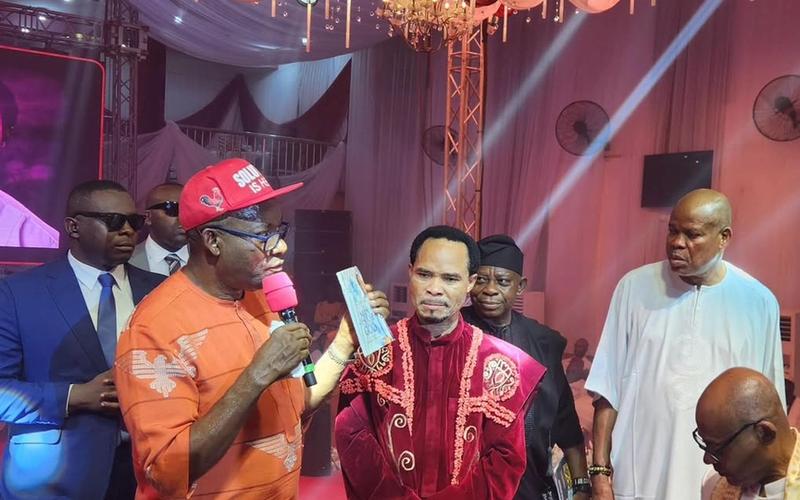
In Nigerian political commentary, selective memory is often weaponized faster than fact-checking. A recent opinion piece accusing Anambra State Governor, Prof. Chukwuma Charles Soludo, of hypocrisy over his stance on keeping politics out of the pulpit is a textbook example of how a carefully constructed straw man can collapse under the weight of its own context. Standing before the congregation at the 30th anniversary of the Mountain of Holy Ghost Intervention Deliverance Ministry in Onitsha, Soludo issued a clear, unambiguous charge to the political class: stop turning altars into campaign soapboxes. "Politicians, there is a venue for politics. If you want to worship God, you'll go to the house of God. We must separate the two things clearly," he declared.
Rather than engaging the substance of that message, his critics chose to twist his exact words—claiming the governor pretended he had never stepped foot in a church during an election cycle, only to be "exposed" by archival photographs.
That framing relies on a deliberate distortion of what Soludo actually said. At no point did the governor claim he vanished from religious life or avoided fellowships altogether. His words were surgical and specific: "Six months before my election, I took a deliberate decision. I never went to any church to cup a microphone to ask them to vote for me or to campaign. It was a deliberate decision. I worship in the government chapel until the election day and afterwards." There is a world of difference between mounting an altar to solicit partisan votes and appearing in a sanctuary as a citizen, a guest, or an official accompanying the state’s chief executive. By equating mere attendance—or a general civic call for citizens to go out and vote—with active electoral canvassing, some writers invented a contradiction where none exists. Even some of the piece's own chronology betrays a hurried, careless prosecution of the facts, strangely interrogating Soludo over a non-existent "2019 election campaign" when his governorship run took place in 2021 and his re-election in 2025.
Nowhere is this sleight of hand more obvious than in the writers' reliance on photographs from the Adoration Ground of Rev. Fr. Emmanuel Obimma (Ebube Muonso) at Uke prior to the 2021 election. Presented without context, the images are meant to serve as a smoking gun. Put back into real-world perspective, however, the narrative falls apart. Soludo did not storm Uke to hijack a prayer vigil for partisan gains; he was part of a delegation led by the then-sitting Governor, Willie Obiano, who attended in his capacity as the state's leader. In Nigerian governance, accompanying an incumbent governor to a major religious gathering—especially in a state where faith institutions are deeply woven into civic life—is standard protocol, not an act of solo pulpit-politicking. Even when partisan mufflers or party colors are visible at public gatherings, presence in a governor's entourage is fundamentally different from seizing a church microphone to turn a worship service into a political rally.
Indeed, Soludo’s record across multiple election seasons demonstrates a remarkably consistent boundary between faith, civic duty, and partisan campaigning. As he noted himself, in the six-month sprint leading up to his governorship election, he intentionally restricted his regular Sunday worship to the Government House chapel precisely to avoid turning parish visits into transactional vote-hunting tours. When he did attend major religious milestones—whether solemnizing with Catholic, Anglican, or Pentecostal congregations during diocesan synods, priestly ordinations, or thanksgiving services—his remarks consistently centered on moral rebirth, community security, and Anambra’s collective destiny rather than partisan sloganeering. Even during the high-stakes heat of his 2025 re-election season, Soludo maintained that same discipline, keeping his church appearances strictly anchored to ecumenism and his constitutional role as the father of the state, leaving the noisy business of political mobilization to town halls, ward rallies, and campaign grounds.
As he pointedly summarized in Onitsha, "My visit to religious institutions is usually motivated by my commitment to ecumenism and responsibility as the father of all in the state." True consistency of character is not measured by whether a leader avoids the house of God during an election year, but by whether he respects the sanctity of the altar enough not to turn it into a political marketplace. By refusing to "cup a microphone" for votes in the sanctuary—both when he was a candidate following his predecessor's lead and now as a sitting governor—Soludo has not contradicted his past; he has simply held the line that Nigerian politics so desperately needs.